The Patentability of Artificial Neural Networks: Lessons from the UK Supreme Court for Indian Patent Law
Introduction Can an Artificial Neural Network (“ANN”) be patented? This question has puzzled courts across various jurisdictions, and the recent UK Supreme Court judgment in Emotional Perception AI Ltd. v. Comptroller General of Patents, Designs and Trade Marks contains some valuable lessons for Indian patent law. Although UK and Indian patent law vary significantly, the […]
Software Patents in India: Understanding Section 3(k) of the Patents Act
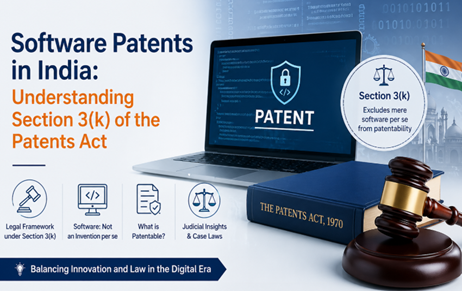
Introduction Software has become an essential part of modern technology. Numerous inventions in the modern world rely on computer programs, computer systems, and automated systems. Online services, banking technology, telecommunications, and artificial intelligence are some of the industries that strongly depend on software-based solutions. Due to this growing reliance on software, there is a highly […]
Rise of Blockchain and the Question of Patentability

1.Introduction It started in 2008, when Satoshi Nakamoto came up with a ground-breaking idea of bitcoin and cryptographic proof that relies on CPU power to create immutable, tamper-proof ledgers which operate on a peer-to-peer architecture. Blockchain, was initially introduced only for Bitcoin and to ensure a consensus-based economic transaction, eradicating the need for a trusted third […]
Revised Guidelines for Examination of Computer-related Inventions (CRIs)
On 30th June 2017, the Office of the Controller General of Patents, Designs, and Trade Marks (CGPDTM) published Revised Guidelines for Examination of Computer-related Inventions (CRIs) that are applicable with immediate effect. The revised guidelines have replaced the Guidelines for Examination of CRIs, published on 19th February, 2016. The revised guidelines are short and precise as […]