

Introduction :
For enterprises managing thousands of active assets, the most harrowing realization isn’t losing high-stakes litigation, but the quiet, ongoing loss of unmonetized value. Consider a classic Tier-1 telecommunications or semiconductor corporate IP team: they sit on five thousand patent families, yet manual screening caps out at a few dozen assets per quarter. While competitors launch hundreds of micro-features, multi-million-dollar evidence of use (EoU) remains buried under dense, unread legal prose.
The traditional approach relies heavily on human memory and static spreadsheets, a fragmented workflow that scales poorly. When portfolios grow, manual monitoring becomes mathematically impossible, leaving significant licensing revenue completely on the table. This operational bottleneck forces IP teams into a reactive posture, creating a persistent blind spot. High-value, infringed assets slowly march toward expiration, their monetization potential completely unlocked, simply because an analyst could not connect a specific claim limitation to a buried line of product documentation.
To monetize dormant patent portfolios, corporate strategy must pivot from defensive maintenance to algorithmic intelligence. Manual analysis struggles with the vast chasm between macro level patent volume and micro level claim boundaries. By injecting machine learning into this workflow, organizations can ingest global product launches, parse multi dependent claims using natural language processing (NLP) and isolate high probability infringement candidates in minutes.
What follows is an operational blueprint illustrating how AI architectures reinvent portfolio clustering, product-to-claim mapping and competitive monitoring to maximize ROI.
1. Technology Background & Core AI Architectures
Integrating deep learning frameworks across legacy infrastructure bridges the gap between raw legal text and actionable business intelligence, neutralizing manual bottlenecks.
1.1. Transformer Driven Claim Parsing
Deploying specialized Large Language Models (LLMs) trained on legal technical corpuses allows systems to isolate independent claims, dependent limitations and functional antecedents. Through custom tokenization and dependency parsing, these models build hierarchical claim trees that preserve the precise legal logic of the document. For instance, an AI parser can automatically extract a five element independent claim in a database architecture patent breaking it down into distinct physical limitations for structural mapping.
1.2. Vector Embeddings and Dense Semantic Space
By mapping text based patent claims and product manuals into a high dimensional vector space, geometric proximity represents deep conceptual similarity rather than exact keyword matches. Utilizing cosine similarity metrics, advanced embedding models map legalistic phrases to commercial technical documentation. An operational engine can, for example, place the legal phrase “plurality of resilient retention members” within 0.92 cosine similarity of the consumer hardware term “snap fit plastic tabs”, establishing an overlap that keyword based indexing would miss.
1.3. Cross-Domain Lexicon Bridges
To resolve the lexical divergence between patent drafting and market nomenclature, machine learning systems utilize cross domain lexicon bridges. Trained on dense technical ontologies, medical vocabularies and historic patent-to-product data, these models perform synonym expansion and jargon translation. This architecture ensures that the system automatically bridges the CPC classification definitions for wireless energy transmission directly with Bluetooth LE/Qi product specification documents.
2. AI-Driven Portfolio Clustering
2.1. Unsupervised Machine Learning for Macro Triage
Managing an unindexed portfolio requires rapid macro-triage that transcends legacy IPC/CPC categories. Applying unsupervised machine learning algorithms such as K-means clustering, Latent Dirichlet Allocation (LDA) and Affinity Propagation (AP) allows systems to discover hidden technological themes across massive datasets. For example, an electric vehicle manufacturer running Affinity Propagation clustering on 10,000 acquired assets can instantly segregate battery electrochemistry patents from solid state inverter designs thereby accelerating strategic triaging.
2.2. Dynamic Cluster Refinement via Active Learning
To mitigate false positives, the system incorporates an active learning loop. Human-in-the-loop interactions allow brief analyst validations to dynamically recalibrate the semantic boundaries of AI generated technology clusters. If a telecom IP manager marks three patents as “falsely clustered” the algorithm instantly updates its weights and repositions 400 related physical layer signaling assets across the vector space to refine subsequent automated mapping accuracy.
3. Automated Product Claim Comparison via NLP
3.1. Automated Evidence Harvesting
To build high-value claim charts, autonomous scraping agents continuously crawl web scale unstructured public data, 10-K/8-K financial filings, whitepapers, developer documentation and regulatory disclosures. These agents act as automated miners for potential infringing indicators. In practice, an AI agent can continuously crawl SEC filings and GitHub repositories to find evidence of a competitor using a proprietary distributed ledger mechanism without requiring manual oversight.
3.2. [Element-by-Element] Infringement Mapping
Once product data is ingested, the system executes an element-by-element infringement mapping protocol. Each distinct limitation of an independent claim is programmatically checked against specific product features to calculate structural overlap, accounting for literal infringement checking and doctrine of equivalents parsing.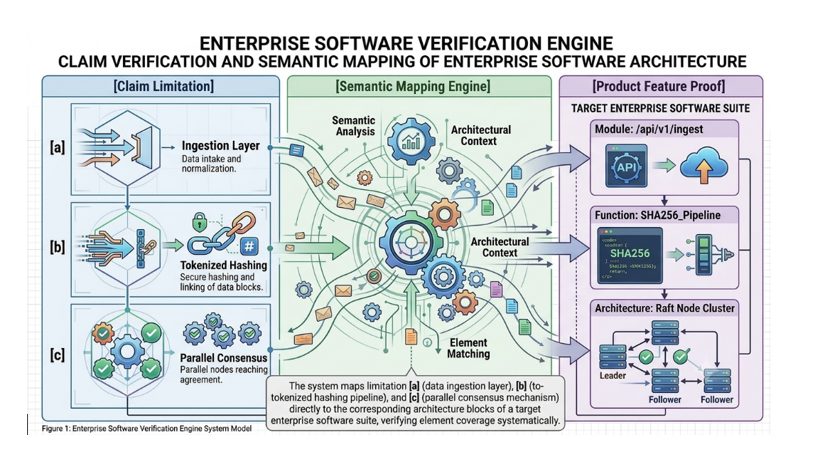
3.3. Confidence Scoring and Read Strength Evaluation
To manage reviewer bandwidth, the engine calculates a quantitative risk scoring matrix. These high confidence alignment signals leverage color coded indicators to prioritize legal review and optimize false positive mitigation. For instance, an AI tool flags a patent product match as “Disclosed (Green)” for direct literal alignment, while flagging another as “Suggested (Orange)” due to missing explicit evidence for a specific sub-element and shielding the team from cognitive exhaustion.
4. Prior Art & Competitive Product Monitoring
4.1. Continuous Market Surveillance Watchtowers
Infringement detection must shift from static, project based reviews to a dynamic live alert infrastructure. By establishing a continuous product watchtower, enterprise teams execute dynamic delta analysis on competitor lifecycles. A consumer electronics giant setting up an AI watchtower can instantly flag a competitor’s new smartphone launch because its camera sensor firmware matches an active pixel binning patent and converting a passive asset into an active enforcement window.
4.2. Defensive Prior Art Aggregation via AI
Before initiating a high stakes monetization campaign, the AI engine executes an automated invalidity triage. By cross referencing global databases and non patent literature (NPL), it identifies risk factors in the patent’s own lineage. For instance: prior to initiating an infringement campaign, an IP firm’s AI engine can uncover a 2018 Japanese academic thesis that represents critical prior art, saving the firm from a costly counter-invalidity action during litigation.
5. Strategic Value and Commercial Benefits to IP Teams
5.1. Compressing the Monetization Lifecycle
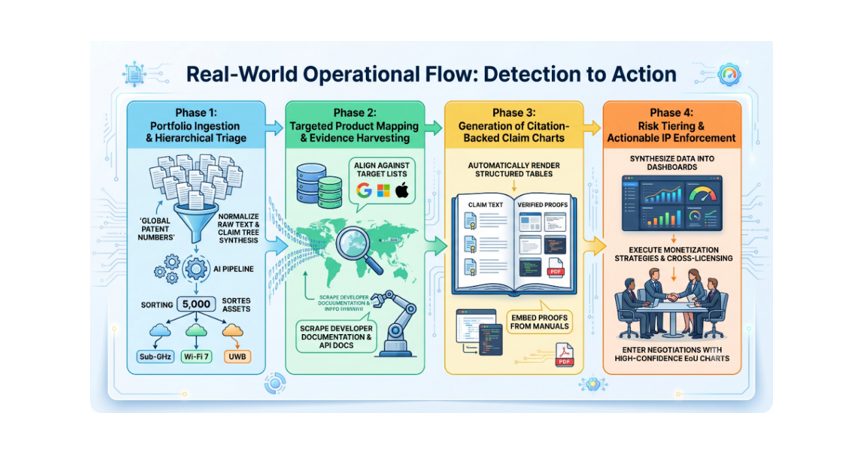
The paramount commercial benefit of algorithmic triage is the drastic cycle time reduction required to move from raw portfolio screening to actionable court ready licensing packages. A licensing entity utilizing automated claim charting engines can compress its standard 9 month portfolio valuation process down to 14 business days rapidly closing a multi million dollar licensing deal before the monetization window narrows.
5.2. Eliminating Human Blind Spots and Review Fatigue
Manual reviews of dense, hundreds-of-pages long patent specifications inevitably suffer from human cognitive exhaustion. Algorithmic engines provide systematic accuracy and uniform data processing, maintaining an auditable trail across every asset. As an example, an AI system reviewing an abandoned acquisition portfolio can surface two “hidden gem” patents with broad claim scope that human reviewers had passed over due to dense, opaque wording.
5.3. Navigating the AI-Driven IP Era
The transition from manual portfolio screening to AI driven infringement detection is not merely an operational upgrade; it represents a fundamental paradigm shift in intellectual property management. As patent portfolios grow exponentially more complex, the firms and corporations that thrive will be those that view AI not as a replacement for human expertise but as a force multiplier. By offloading the brute force computational tasks such as semantic clustering, multi jurisdictional product monitoring and initial claim-to-product mapping to advanced NLP engines, IP teams are liberated to focus on high value strategic execution. The future belongs to the augmented patent professional who can rapidly transform machine generated technical overlaps into high stakes licensing revenue, bulletproof litigation strategies and precise FTO (Freedom to Operate) determinations.
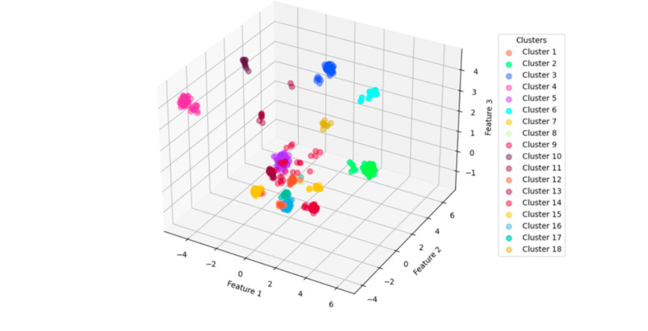
Figure 1: High Dimensional Semantic Clustering of Latent Patent Themes
Looking ahead we are moving toward a continuous as well as proactive ecosystem of IP monetization. Imagine a landscape where portfolio monitoring is no longer a periodic or reactive audit but a real time autonomous engine. Emerging AI frameworks will soon dynamically cross reference newly issued claims and real time product launches across global markets. Thereby instantly flagging potential infringement vectors the moment they surface. This shift from defense to offense will redefine competitive intelligence, compressing the timeline from infringement detection to actionable enforcement from months to mere hours. For visionary IP leaders, chief technology officers and patent strategists adopting these machine learning methodologies is the definitive way forward turning intellectual property from a passive legal shield into an active high yield driver of corporate growth and market dominance.
Author : Sanjay Sharma, In case of any queries please contact/write back to us via email to [email protected] or at IIPRD