

Introduction
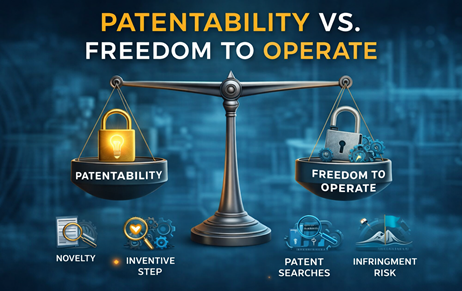
Suppose you have just invented a smart gadget and you apply for a patent so that you feel protected. But then just as you are ready to launch you get a legal notice that someone says you are infringing their patent even though you have one yourself. This is where two important ideas come in Patentability and Freedom to Operate (FTO). Patentability is about whether your invention is new and innovative enough to get a patent and freedom to operate is about whether you can use your invention in the market without violating someone else’s patent. This confusion can lead to serious legal and financial trouble especially in industries like pharmaceuticals, biotechnology and tech where innovation moves fast and patent landscapes are crowded.
This article breaks down the difference between patentability and FTO and explain how they are connected, why both matter and which one should be prioritize depending on the stage of innovation.
Understanding the Concepts
What is Patentability?
A patent is an exclusive legal right granted by a government to an inventor, giving them sole ownership over their invention, process, or design for a fixed period. In return for this monopoly, the inventor must fully disclose the details of their invention. Unlike physical property, a patent is an intangible (incorporeal) right, meaning it protects ideas and innovations rather than tangible objects. In India these rules are mainly found in the Indian Patents Act, 1970 especially under Sections 2(1)(j) and 3.
To be patentable your invention must be:
- Novelty (New) – It should be new and not known to the public anywhere in the world. The invention must not already exist anywhere in the world (Section 2(1)(l)).
- Inventive Step (Non-obvious) – It should not be something that anyone in the field could easily think of (Section 2(1)(ja)).
- Industrially applicable (Usefulness) – It must have a practical use in any industry (Section 2(1)(ac)).
The Indian Patent Office checks if your invention meets these conditions before granting a patent. They do not decide if you can sell or use the invention just whether you can get a patent for it. Example- If you invent a new type of phone charger the Patent Office will check if it is truly new, not obvious and useful. If yes you get a patent but that does not mean you might not infringe someone else’s patent when selling it.
 What is Freedom to Operate (FTO)
 What is Freedom to Operate (FTO)
Freedom to Operate (FTO) means checking whether your business can legally make, use, or sell a product without accidentally violating someone else’s patent rights. To ensure FTO companies conduct a thorough patent search in the countries where they operate. This helps spot any existing patents that could block their business plans. By doing this early, businesses can avoid costly lawsuits and make smarter decisions about their products or services.
FTO means you can make, use or sell your product or process without infringing on someone else’s existing patent. Even if your invention is new and patentable it might still include parts or technologies already patented by others. If so using or selling your invention could get you into legal trouble for patent infringement (under Section 108 of the Patents Act). FTO is all about market safety not about getting a patent. It requires a careful check often done by legal experts of other active patents in the countries where you plan to sell.
Key Differences Between Patentability and Freedom to Operate
- Patentability checks if your invention is new, non-obvious and useful to get a patent (Sections 2(1)(j), 2(1)(ja) of Patents Act). Whereas FTO checks if selling/making your product violates others’ patents.
- Patentability is decided by the Patent Office (they approve/reject applications). Whereas FTO is decided by you/lawyers (through searches to avoid infringement risks).
- Patentability is mainly done before filing a patent (to get legal rights) and FTO is done before launching a product (to avoid legal trouble).
- The main risk in Patentability is that patent application may be rejected by the Patent Office if your invention fails to meet the legal requirements (novelty, inventive step, industrial applicability) whereas the main risk in is that Even with a granted patent your commercial activities may infringe on others’ existing patent rights, potentially leading to costly litigation and injunctions.
These the primary differences between Patentability and FTO.
The Roche v. Cipla case is one of the most important Indian cases that shows the clear difference between patentability and FTO. Roche and Pfizer had a patent in India for a cancer drug called Erlotinib which was considered an important innovation. This means that their invention was considered patentable under Indian law as it was new, useful and met the legal criteria under the Patents Act. But when Cipla an Indian pharmaceutical company launched a cheaper and generic version of the same drug Roche sued them for patent infringement and asked the court to stop Cipla from selling it. Cipla argued that even though Roche had a patent, its version was different and more affordable and that public interest should be considered. The court initially refused to stop Cipla from selling the drug because it was more accessible to Indian patients. Later the court found that Cipla’s product did infringe Roche’s patent and awarded damages. This case is a clear example of how having a patent (patentability) does not always mean you can block others or freely use your own invention in the market (freedom to operate). The court looked at public health, pricing and the technical details of both drugs showing that both patent rights and the right to operate must be carefully balanced. It also highlighted how Indian law especially Section 3(d) protects against evergreening and ensures that only truly innovative inventions get patent protection.
Why Both Are Important
Many people think that getting a patent means they are free to use their invention in the market. But that is not true. Patentability and Freedom to Operate (FTO) are two different things and both are equally important. Let us say you create a new feature that improves an already existing product. You apply for a patent and it gets granted under Section 2(1)(j) of the Indian Patents Act, 1970. That means your invention is patentable which means it is new, non-obvious and useful. But the problem is the original product is still protected by someone else’s patent. If you try to sell your improved version without their permission you could be sued for infringement under Section 108 which allows courts to stop you and even award damages. This is where FTO becomes important as it checks if your invention is safe to use or sell in the market without stepping on someone else’s legal rights.
At the same time if you do not protect your own invention through a patent someone else might copy it. You would lose your competitive edge and have no legal way to stop them. So, while patentability helps you protect your innovation, FTO helps you avoid legal trouble and because of this to succeed in business or research you need both.
Which One to Prioritize and When
Choosing between patentability and freedom to operate (FTO) depends on what stage you are in. In the beginning when you are still developing your product or idea it is more important to focus on patentability. This means checking if your invention is new, useful and not obvious under the law especially under Section 2(1)(j) of the Indian Patents Act, 1970. Getting a patent or at least filing for one show that you have ownership of your innovation. It also makes your idea more attractive to investors and helps you build your brand and market value early on.
However, when you are closer to launching your product in the market the focus must shift to freedom to operate (FTO). Even if you have a patent for your product, you can still run into legal trouble if your invention uses parts or technology that someone else already holds a patent for. If you do not check this before entering the market you might face lawsuits, injunctions, or heavy damages under Section 108 which deals with patent infringement. Ideally if you have enough resources both patentability and FTO should be considered side by side. Patentability helps you protect your own invention, while FTO helps you avoid stepping on someone else’s rights. Understanding when to focus on each can save you time, money, and legal trouble in the long run.
Conclusion
Understanding the difference between patentability and freedom to operate (FTO) is essential for anyone involved in innovation especially in fields like pharmaceuticals, biotech and technology. While patentability as defined under Sections 2(1)(j) and 3 of the Patents Act, 1970 helps to protect your invention FTO ensures that using or selling that invention would not violate someone else’s rights. Failing to check either can lead to lost business opportunities or legal trouble. Innovators, legal teams and research departments should always include both patentability assessments and FTO analyses as part of their product development process. In a world where competition and regulation are growing rapidly strategic planning of intellectual property is no longer optional, it is a necessity. Combining innovation with legal foresight is the key to long-term success.
Author: Rishav Srivastva, in case of any queries please contact/write back to us via email to [email protected] or at IIPRD.
References
- The Patents Act, 1970 (Act No. 39 of 1970), § 2(1)(j).
- The Patents Act, 1970 (Act No. 39 of 1970), § 3.
- The Patents Act, 1970 (Act No. 39 of 1970), § 2(1)(l).
- The Patents Act, 1970 (Act No. 39 of 1970), § 2(1)(ja).
- The Patents Act, 1970 (Act No. 39 of 1970), § 2(1)(ac).
- The Patents Act, 1970 (Act No. 39 of 1970), § 108.
- Hoffmann-La Roche Ltd. v. Cipla Ltd., 148 (2008) DLT 598.
- Novartis AG v. Union of India & Ors., (2013) 6 SCC 1.
- World Trade Organization (WTO), Agreement on Trade-Related Aspects of Intellectual Property Rights (TRIPS), Article 27 – Patentable Subject Matter, April 15, 1994, https://www.wto.org/english/docs_e/legal_e/27-trips.pdf.
- Controller General of Patents, Designs and Trade Marks, Manual of Patent Office Practice and Procedure – Chapter 08: Inventive Step Assessment, 2023, https://ipindia.gov.in/writereaddata/Portal/IPOGuidelinesManuals/1_31_1_manual-of-patent-practice.pdf.
- United States Patent and Trademark Office (USPTO), Manual of Patent Examining Procedure (MPEP) – Section 2141: Examination Guidelines for Determining Obviousness, 9th Edition, June 2024, https://www.uspto.gov/web/offices/pac/mpep/s2141.html.
- European Patent Office (EPO), Guidelines for Examination – Part G, Chapter VII: Inventive Step (Problem-Solution Approach), November 2024, https://www.epo.org/law-practice/legal-texts/html/guidelines/e/g_vii.htm.
- National Intellectual Property Administration (CNIPA), Guidelines for Patent Examination (2023 Revision) – Part II, Chapter 4: Inventiveness, https://www.cnipa.gov.cn/art/2023/12/21/art_53_189456.html.
- Bar & Bench, Roche v Cipla Revisited: Patentability Does Not Guarantee Freedom to Operate, 2024, https://www.barandbench.com/news/roche-v-cipla-patentability-fto.
- LiveLaw, Understanding Patentability and FTO in Indian Patent Law: A Strategic Guide, 2025, https://www.livelaw.in/articles/patentability-vs-fto-indian-patent-law-2025.
- WIPO, Standing Committee on the Law of Patents (SCP) – Comparative Study on Inventive Step and Freedom to Operate, SCP/28/3, 2018 (Updated 2024), https://www.wipo.int/edocs/mdocs/scp/en/scp_28/scp_28_3.pdf.
- Indian Patent Office (IPO), Examination Guidelines – Freedom to Operate vs Patentability Distinction, 2024, https://ipindia.gov.in/writereaddata/Portal/IPOGuidelinesManuals/1_31_1_FTO_vs_Patentability.pdf.
- NASSCOM, Intellectual Property Strategy for Indian Startups – Patentability and FTO Best Practices, 2025 Report, https://nasscom.in/knowledge-center/publications/ip-strategy-startups-2025.
- World Intellectual Property Organization (WIPO), WIPO Patent Landscape Report – Freedom to Operate in Emerging Technologies, 2025, https://www.wipo.int/publications/en/details.jsp?id=56789.