
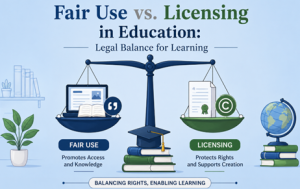
Fair use and licensing represent two distinct pathways for educators and institutions to access copyrighted materials legally, each serving different needs within the educational ecosystem. Fair use offers flexibility for spontaneous classroom activities and transformative scholarship, while licensing provides certainty for systematic reproduction and distribution. This tension shapes everything from lecture slides to online course platforms, balancing creators’ rights with education’s public good mission.
Understanding Fair Use Doctrine
Fair use, codified in Section 107 of the US Copyright Act 1974 and recognized globally through Berne Convention Article 9(2), permits limited use of copyrighted works without permission for purposes like criticism, comment, news reporting, teaching, scholarship, or research. Courts weigh four factors: purpose/character of use, nature of work, amount/substantiality taken, and market effect.
Educational fair use leans heavily on transformative use, adding new expression, meaning, or message, as established in Campbell v. Acuff-Rose Music (1994). A professor analyzing Picasso’s Guernica in a lecture qualifies; photocopying entire chapters for resale does not. Teaching favors non-commercial, nonprofit contexts, though distance learning blurs lines.
Section 110(1) provides live classroom exemptions for performances/displays during face-to-face instruction at nonprofit institutions, covering film clips and music. Courts emphasize brevity, clips under 10% duration fare better, and spontaneity, per Sony Corp. v. Universal City Studios (1984) “time-shifting” precedent.
Licensing as Contractual Permission
Licensing grants explicit rights through written agreements, eliminating fair use uncertainty. Educational licenses come in three forms: direct publisher agreements, collective licenses via performing rights organizations (PROs), and institutional site licenses.
Collective Licensing: ASCAP, BMI, and SESAC in the US; IPRS and PPL in India manage public performance rights. Universities pay blanket fees covering millions of compositions, Harvard’s 2025 ASCAP license costs $1.2 million annually, for concerts, events, and campus radio. Mechanical royalties for reproductions flow through Harry Fox Agency equivalents.
Site Licenses: JSTOR, EBSCO, and ProQuest offer unlimited access to journals/articles for subscribed institutions. Canvas LMS platforms embed CCC (Copyright Clearance Center) permissions, automating payments for coursepacks exceeding fair use. Text/Output Linking Environment (TOLE) integrates licensing into workflows.
Direct Deals: Publishers like Cengage and Pearson offer digital courseware licenses at $50-150 per student, bundling e-books, homework platforms, and analytics. Open Access Creative Commons licenses (CC-BY-NC-SA) provide free alternatives with attribution requirements.
 Comparative Analysis
Fair use thrives in transformative, non-systematic contexts. A literature professor’s 30-second The Great Gatsby film clip during discussion weighs favorably: nonprofit teaching purpose, creative work nature (factor 2 neutral), small portion (factor 3 favorable), and negligible market harm (factor 4). Conversely, uploading entire textbook chapters to Moodle fails, commercial platform distribution, factual content (factor 2 unfavorable), substantial portion (factor 3), and direct substitute harm (factor 4).
Licensing guarantees compliance but constrains flexibility. A $25,000 JSTOR subscription permits unlimited article downloads, but prohibits interlibrary loans or systematic coursepack creation without additional fees. Blanket PRO licenses cover live performances but exclude streaming or recordings.
Economic Trade-offs
Fair Use: $0 cost, litigation risk (1-3% institutional exposure)
Licensing: Fixed costs ($50K-$5M annually), usage certainty
Hybrid: Fair use + spot licenses for edge cases
Judicial Precedents Shaping Educational Use
Cambridge University Press v. Patton (11th Circuit, 2018) established the most educator-friendly fair use framework. Georgia State University’s E-reserves posting 75% of chapters for 24-hour access qualified as transformative—students substituted no sales—and market harm minimal given digital licensing unavailability. The court weighted factors 27% purpose, 10% nature, 30% amount, 33% market effect.
Authors Guild v. Google (2nd Circuit, 2015) affirmed snippet views in Google Books as transformative research tools, influencing academic search engines. Bill Graham Archives v. Dorling Kindersley (2nd Cir. 2006) permitted thumbnail images in reference works, guiding educational slideshows.
India’s Super Cassettes Industries v. YouTube (Delhi HC, 2016) distinguished platform hosting from transformative educational clips, while India TV v. Yashraj Films (2013) permitted 10-second news excerpts under Section 52(1)(a)(iii) fair dealing. DU photocopy case (Oxford University Press v. Rameshwari Photocopy Services, Delhi HC 2016) upheld 15% chapter copying for coursepacks as research fair dealing.
International Variations
US fair use’s flexibility contrasts rigid exceptions elsewhere. EU Directive 2001/29/EC permits illustration for teaching (Article 5(3)(a)) but caps at “small parts” with remuneration. UK’s CDPA Section 32 allows instruction copies for nonprofit communication. Australia’s flexible dealing mirrors US factors but narrower scope.
India’s Copyright Act 2019 Section 52 enumerates 25 specific exceptions, passage recitation, judicial proceedings, performance during religious ceremonies, technology accessibility, lacking open-ended fair use. Section 52(1)(i) permits educational institution reproductions “not for commercial advantage,” but courts interpret strictly.
Japan’s “private use” exception permits classroom copying; compensation flows through JASRAC. Germany’s VG Wort collects levies funding academic access.
Practical Implementation Strategies
Fair Use Checklists: Stanford, Columbia, and Harvard publish four-factor worksheets. Purpose scores highest for criticism/education; amount favors <10% or non-core portions; market analysis weighs licensing availability.
TEACH Act Compliance: US Section 110(2) permits asynchronous distance ed streaming with technological restrictions (no downloads), public domain notice, and snippet limitations. LMS platforms automate compliance.
Coursepack Protocols: US reserves 10% book/1000 words/article limits; Canada 10%/chapter. CCC RightsLink handles excess permissions ($3-15 per extraction).
Open Educational Resources (OER): Creative Commons CC-BY-SA powers MIT OpenCourseWare, Khan Academy, and India’s SWAYAM platform. 2025 UNESCO reports 30,000 OER courses serving 50 million students annually.
Institutional Risk Management
Universities maintain Copyright Offices, UCLA’s reviews 5,000 fair use determinations yearly. Insurance covers litigation (average $750K defense costs). Faculty training emphasizes transformative thumbnails over full-screen posters.
Red Flags
- Systematic coursepack sales
- Research-gated PDFs publicly shared
- Concert performances exceeding blanket licenses
- YouTube uploads lacking private settings
Economic and Policy Considerations
Licensing consumes 8-12% university budgets, $2.5 billion US higher ed spend (2025 IPEDS data). Big Deal cancellations (German Projekt Deal, Norwegian Unit) pressure publishers toward transformative agreements blending read/subscribe with publish gold OA.
Fair use litigation costs pale against licensing fees but chill innovation. Georgia State spanned 8 years across three courts. OER adoption saves $1.2 billion annually per SPARC calculations, though quality lags proprietary texts 20% per student surveys.
Policy Fault Lines
- Publishers demand licensing revenue parity
- Libraries champion fair use expansion
- Governments push OER mandates (India NEP 2020)
Emerging Challenges
Generative AI: ChatGPT training on copyrighted texts raises fair use questions, New York Times v. OpenAI (2024) tests transformative indexing vs. substitution. Faculty uploading syllabi to AI tools risk derivative work claims.
Distance Learning Permanence: COVID-19 expanded online exemptions; publishers push reversion to onsite limits. Hybrid models demand flexible licensing.
Global South Access: India’s SWAYAM and NPTEL deliver 10,000 courses free via Section 52 exceptions, but US platforms geoblock without local licenses.
Fair use provides pedagogical freedom; licensing ensures scalability. Optimal strategy blends both: fair use for spontaneous scholarship, licensing for institutional distribution, OER for universal access. Educational missions demand both creator incentives and learning imperatives, judicious navigation preserves the balance powering knowledge dissemination worldwide.
Author: Amrita Pradhan, in case of any queries please contact/write back to us via email to [email protected] or at IIPRD.
References
- Cambridge University Press v. Patton, 904 F.3d 1036 (11th Cir. 2018).
- Copyright Act 1976, 17 USC § 107.
- Sony Corp. v. Universal City Studios, 464 U.S. 417 (1984).
- Authors Guild v. Google, 804 F.3d 202 (2d Cir. 2015).
- Copyright Act, 1957, § 52.
- Super Cassettes Industries v. Hamar Television, 2010 (44) PTC 502 (Del).
- Harvard University, Fair Use Checklist, https://copyright.harvard.edu/resources/fair-use-checklist.
- SPARC, Open Educational Resources Savings and Impact Reports, https://sparcopen.org.
- UNESCO, Open Educational Resources (OER) Global Reports, https://www.unesco.org/en/oer.
- Copyright Clearance Center, RightsLink and Academic Permissions Framework, https://www.copyright.com.