Introduction India plays an important role in the global pharmaceutical industry as a major drug…
Standard Essential Patents and FRAND Licensing in India: Navigating the Intersection of Patent Law and Competition Policy
Introduction
The smartphone which is used today is the result of thousands of technologies which are patented and which work in a coordinated fashion. When a device goes online to a 4G network, a video stream or a voice call is sent, it uses technical standards agreed upon protocols that make all devices and manufacturers in the world interoperable. They are created by Standard Setting Organisations (or SSOs) such as ETSI and IEEE, these are the unseen foundations of the world telecommunications sector.
Patents on technologies used in such standards are referred to as Standard Essential Patents (SEPs). SEP, unlike regular patents, holds a unique legal position: a manufacturer of a device that needs to be standard compliant has no technological choice other than to adopt the patented technology. To curb the misuse of this structural market power, SSOs require members contributing technology to a standard to commit to licensing their SEPs on Fair, Reasonable, and Non-Discriminatory (“FRAND”) terms, a framework designed to balance the legitimate interests of innovators with the imperative of widespread technology adoption.
India, the second largest telecommunications market in the world with more than one billion mobile subscribers and a 5G rollout has become one of the most impactful places of SEP disputes in the world. The Delhi High Court has resolved a number of landmark cases, in which global SEP holders and Indian device manufacturers were involved, gradually developing a body of jurisprudence which has attracted the attention of the international community. This blog follows this evolution, especially the historic decision in Telefonaktiebolaget LM Ericsson v. Lava International Ltd. (2024)[i]. It also discusses the issue of the unresolved jurisdictional conflict between the Patents Act, 1970 and Competition Act, 2002 and states that India is becoming an increasingly important technology manufacturing hub that is in need of a legislative fix.
SEPs and FRAND: The Legal Framework.
Technical standards represent the result of joint work of rival technology organizations. When a company’s patented technology becomes indispensable to the implementation of such a standard, that patent is designated a Standard Essential Patent. The establishment of essentiality is done by the declaration by the holder of the patent to the concerned SSO. Importantly, SSOs have no independent checking of whether a proclaimed patent is indeed necessary, but they based on the statements of the professing party. This lack of independent verification allows a phenomenon called over-declaration where patent holders declare patents as necessary without intense examination.
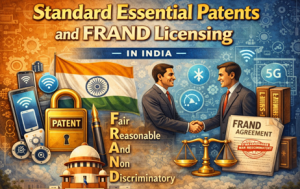 The FRAND commitment is based on SSO membership policies. The IPR Policy of ETSI, an example, is that members must make irrevocable licenses on FRAND terms to participate.[ii] Every aspect of the commitment have legal implications: “Fair” is that the terms must be fair; “Reasonable” is that the royalty rates should reflect the actual contribution of the patented technology to the standard; and “Non-discriminatory” is that the holder of the SEP must offer similar terms to similarly situated license.
In SEP licensing, there are two types of abuse that are likely to occur. Patent holdup, when a SEP holder, who knows that an implementer has already pledged to the standard and cannot escape the patented technology, asks for royalty payments higher than it deserves. Here, the implementer intentionally rejects negotiations to obtain rates below FRAND. They both have been the center stage in Indian SEP wrangling. The Patents Act, 1970 does not include any definition of an SEP, there is no mention of FRAND requirements and there is no standard of calculating FRAND royalty rates. The general principles of patent working and compulsory licensing are dealt with in Section 83 and 84[iii] of the Act respectively and neither of them was intended to meet the difficult issues of SEP licensing. The whole jurisprudence of SEP in India has thus been built case by case by courts, as there is no legislative direction.
The Landmark case: Ericsson v. Lava International Ltd.
The case of Telefonaktiebolaget LM Ericsson v. Lava International Ltd.[iv] of March 28, 2024, decided by Justice Amit Bansal, is the first in Indian legal history that addresses the issues of SEP and FRAND in their fullest scope. It is the longest Indian judgment to decide FRAND royalty rates following a full evidentiary trial, including expert witnesses, technical analysis and study of confidential licensing arrangements, running to 476 pages.
The case goes back to November 2011, when Ericsson originally approached Lava to licence its SEP portfolio of both 2G and 3G technologies. Following the unsuccessful negotiation of more than three years, Lava had filed a case in the District Court of Noida requesting a statement of FRAND rates and Ericsson had filed the case in the Delhi High Court claiming the infringement of eight SEPs. The Noida suit was moved to the Delhi High Court by the Supreme Court to be amalgamated. It began trial in February 2016 and was concluded in July 2016, with final hearings in between February and May 2023.
On essentiality, the Court allowed Ericsson its claims over seven out of eight patents asserted, and quashed one. It believed that claim mapping charts were a significant instrument in proving essentiality and that Lava had not countered the charts submitted by Ericsson or proven with evidence that the pertinent standards could be adopted using non-infringing methods. Using a two step infringement test to map the patent to the standard then prove that the device of the implementer met the requirements of the standard, the Court found that Lava devices violated all seven patents of the suit that were valid.
The Court expressed the standard that governs in determination of FRAND rates in a manner that has, since, formed the core of Indian SEP jurisprudence. As the Court stated, the essence of a FRAND licence is that it “should be fair in its treatment of both parties, reasonable in its economic demands and non-discriminatory in its application across different licensees.”[v]. The Court declined the top-down method of calculating a royalty offered by Lava on the basis that the Court lacked supporting statistics, and adopted in its place the comparatively similar licensing approach, that is, the existing licence agreements of Ericsson with similarly situated Indian and other global licensees were the most reliable guide to a fair and reasonable calculation of a royalty. The Court based its decision on the rulings of the European Court of Justice and concluded that internationally recognised FRAND principles were “equally applicable in the Indian context”. The FRAND royalty rate was determined at 1.05% of the net selling price of Lava’s devices.
In the issue of willing and unwilling licensees, the Court said that Lava was an “unwilling licensee”, concluding that even after Ericsson had made several good-faith offers, Lava had resorted to intentional delay, made no meaningful counteroffers and wanted access to the confidential third-party agreements of the company as a precondition to any negotiations. The Court awarded damages to Ericsson in the amount of INR 244,07,63,990 (roughly USD 29.24 million) plus 5% per annum interest and actual costs of litigation, on the premise that an implementer of a standard necessarily implements all those SEPs required by that standard.[vi]
The conflict: Patents Act, 1970 vs. Competition Act, 2002
The question that has had the most significant impact in the Indian SEP law is not about royalty rates but is rather about: what regulatory agency has the jurisdiction to adjudicate an issue about licensing practices of a holder of a SEP? The concurrent presence of the Patents Act, 1970 and Competition Act, 2002 has created a conflict of jurisdiction.
At the time when Ericsson had filed the patent infringement complaint on Micromax and Intex, the accused manufacturers also filed the complaint before the CCI on the basis of misuse of dominant position in accordance with the provisions of Section 4 of Competition Act. The CCI discovered a prima facie case and instructed its Director General to start investigations against Ericsson. Ericsson appealed to the Delhi High Court, claiming that the Patents Act, being a special law and regulating all the aspects of patent rights such as the licensing and unfair competition, should take precedence over the Competition Act.
In 2016, the Delhi High Court originally determined that the jurisdiction of the CCI was not displaced by the mere fact that the matter was a patent dispute. But in its judgment dated July 13, 2023, the Division Bench overturned this decision completely. The Division Bench was of the view that the Patents Act, 1970 is a special law and a complete code that deals with all matters concerning the exercise of patent rights and that Chapter XVI of the Act dealing with working of patents, compulsory licensing and revocation gave a complete framework that dealt with the issues that the CCI had been seeking to inquire.[vii]
This decision was appealed to the Supreme Court by the CCI (SLP(C) No. 25026/2023). The Supreme Court gave notice on the petition on March 1, 2024. Then on September 2, 2025, the Supreme Court dismissed the appeals of the CCI[viii], on the basis that the factual substratum of the CCI proceedings had been extinguished by the existence of private settlements, although leaving the question of whether the CCI can ever exercise jurisdiction over anti-competitive conduct based on the assertion of patent rights open.
This jurisdictional controversy is an actual conflict between two valid policy goals. To eliminate the abuse of patents, the Patents Act grants exclusivity and gives remedies like compulsory licensing under Section 84 to tackle the abuse. Competition law, in its turn, is based on the assumption that market behaviour, as well as the conduct of intellectual property owners, should be under scrutiny. In the particular case of SEPs, with market power being structurally ensured by the standard itself, it is hard to maintain as a policy matter to exclude the jurisdiction of competition law altogether.
India’s Missing Framework and its implications
The history of Indian SEP jurisprudence has been developed almost wholly through judicial creativity where legislation has not led the way. In contrast to the European Union, which in 2023 suggested a comprehensive SEP Regulatory framework, creating a centralised system of essentiality tests and FRAND determination, India has no law to define a SEP, stipulate FRAND commitments or establish a regulatory process to determine the royalty. Such a legislative silence has structural implications on all the actors in the Indian technology ecosystem.
It has several shortcomings that are worth noting. First, FRAND commitment in India is only present in the sense of the SSO membership policy that are private contractual agreements with no statutory force. Second, no independent verification of essentiality of patents exists such that all essentiality disputes have to be determined by costly litigation. Third, although the comparable licensing approach has been found by Ericsson v. Lava as a desirable methodology of FRAND determination, this has been developed by the judiciary and not a regulatory standard, so there is a risk of inconsistency in future cases. Fourth, the lack of jurisdiction between the Patents Act and the Competition Act has placed both SEP holders and implementers without a sense of regulatory certainty. Fifth, there is no special SEP dispute resolution body, and thus every case has to go through the general commercial court system in India, a process, as seen in the case of Ericsson v. Lava, it can require almost ten years to bring the case to final decision.
These gaps have practical implications. To the Indian device manufacturers, the case of Ericsson v. Lava sends a clear signal that patent holdout is a costly affair. In response to licensing offers, companies should actively get involved with SEP holders and make a record of their good-faith involvement. To foreign SEP holders, India has affirmed that it is a mature enforcement jurisdiction that has large damages available at trial. In the case of the 5G ecosystem in India, where the standard entails thousands of proclaimed SEPs possessed by a varied set of companies around the globe, the risk of stacking royalties in the absence of a statutory framework may lead to a greater cost in technology adoption.
Conclusion
The SEP and FRAND jurisprudence in India is primarily a creation of judicial ingenuity and legislative inactivity, almost entirely created by litigation. Although landmark cases such as Ericsson v. Lava (2024) have made India an effective SEP enforcement venue, a case-by-case framework agreed upon over fifteen years is an ineffective replacement of statutory certainty. With India moving faster with its 5G deployment and intent to establish itself as a manufacturing powerhouse globally, the lack of a specific SEP framework has real economic implications. The statutory recognition of SEPs, independent essentiality tests and coordinated regulatory guidance are not a dream anymore, they are a necessity.
Author: Anushka Mitra, in case of any queries please contact/write back to us via email to [email protected] or at IIPRD.
END NOTES
[i] Telefonaktiebolaget LM Ericsson v. Lava International Ltd., 2024 SCC OnLine Del 2497
[ii] European Telecommunications Standards Institute, ETSI Rules of Procedure, Annex 6: ETSI Intellectual Property Rights Policy (Nov. 2023), https://www.etsi.org/images/files/IPR/etsi-ipr-policy.pdf
[iii] The Patents Act, No. 39 of 1970, §§ 83–84, India Code (2023), https://www.indiacode.nic.in.
[iv] Telefonaktiebolaget LM Ericsson v. Lava International Ltd., 2024 SCC OnLine Del 2497
[v]Lava International Ltd. v. Telefonaktiebolaget LM Ericsson, 2024 SCC OnLine Del 2497, decided March 28, 2024, as reported in SCC Times (Apr. 6, 2024), https://www.scconline.com/blog/post/2024/04/06/dhc-awards-rs-244-crore-damages-to-ericsson-against-lava-for-patent-infringement-legal-news/
[vi] WIPO Lex Case Summary, High Court of Delhi [2024]: Telefonaktiebolaget LM Ericsson v. Lava International Ltd., 2024:DHC:2698, https://www.wipo.int/wipolex/en/text/591754
[vii] Telefonaktiebolaget LM Ericsson (PUBL) v. Competition Commission of India, LPA 150/2020, Division Bench, High Court of Delhi, decided July 13, 2023
[viii] Competition Commission of India v. Telefonaktiebolaget LM Ericsson (PUBL), SLP(C) No. 25026/2023, Supreme Court of India.
Related Posts