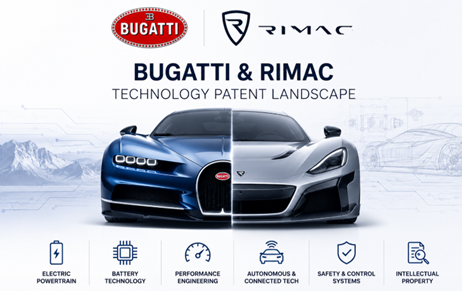
The Bugatti & Rimac technology patent landscape reflects a powerful blend of luxury automotive engineering…
Sun Mobility Patent Landscape Analysis
An in-depth analysis of Sun Mobility’s patent landscape, highlighting innovations in battery swapping technology, EV infrastructure, and clean energy solutions. The study uncovers key trends, strategic filings, and the company’s role in shaping the future of sustainable mobility
Patent Landscape Report · Technology Insight
Sun Mobility's Electric Vehicle IP Portfolio:
A Comprehensive Patent Landscape Analysis of Battery Swapping & Smart Charging Innovation
Assignee: Sun Mobility Pte Ltd · Published by IIPRD · April 2026 · Source: Public Patent Databases
130Patent Records
10+Jurisdictions
2016–2026IP Timeline
91%Portfolio Alive
130IPC Domains
Executive Summary
Executive Summary: Sun Mobility's Intellectual Property Landscape
This patent landscape report presents a structured and data-driven intellectual property (IP) analysis of Sun Mobility Pte Ltd, a Singapore-headquartered innovation leader at the forefront of electric vehicle (EV) battery swapping, smart charging infrastructure, and energy storage management. Drawing upon a systematic review of 130 patent records sourced from publicly available global patent databases, this technology insight report maps the company's IP trajectory, dominant technology focus areas, multi-jurisdictional filing strategy, legal portfolio health, and competitive intelligence landscape across the rapidly evolving EV ecosystem.
Sun Mobility's patent portfolio spans an active decade of innovation — from foundational battery housing and smart access control filings as early as 2016, through to a concentrated cluster of international PCT and national patent applications published in 2025–2026 that signal an unprecedented acceleration in research and development activity. The dominant technology classifications — anchored in IPC B60L (Electric Vehicle Charging and Propulsion), H02J (Power Supply and Management), and H01M (Battery and Electrochemical Systems) — reflect the company's strategic positioning in mission-critical EV infrastructure that enables scalable, battery-as-a-service (BaaS) commercial models.
A striking 91% of the portfolio remains legally alive — with 82.3% in active prosecution (Pending) and 8.5% already granted with enforceable rights. Ten or more jurisdictions are covered, including India, Singapore, Vietnam, Indonesia, the United Kingdom, Brazil, Colombia, Peru, and the Philippines, alongside 47 PCT (WO) international filings that ensure expansive territorial protection. The most significant inflection point in this IP landscape is the 2024 priority year surge of 57 filings, representing 43.8% of the total portfolio in a single year — an unmistakable signal of accelerated commercial scale-up. This report, prepared by IIPRD, offers patent practitioners, IP strategists, technology licensing professionals, and innovation analysts a thorough window into Sun Mobility's intellectual property footprint and future trajectory.
Patent Landscape Analytics — Charts & Insights
Annual Patent Filing Trends — Priority, Application & Publication Year Distribution (2016–2026)
Exponential Patent Filing Growth Signals Sun Mobility's Aggressive IP Portfolio Expansion Strategy
The filing trend analysis across all three temporal dimensions — priority dates, application dates, and publication dates — reveals a company in a pronounced and accelerating phase of intellectual property creation. The earliest priority date on record traces back to 2016, when Sun Mobility's initial IP framework was established with two foundational filings. A more substantive wave followed in 2018 with 15 priority filings — primarily covering battery compartment hardware, smart locking mechanisms, and electronic access control systems — establishing the physical and mechanical IP foundation upon which all subsequent innovation layers were built.
The portfolio remained relatively stable through 2019–2021, a period largely characterised by international prosecution, PCT national phase entries, and the conversion of early applications into granted patents across India and Singapore. The pivotal inflection point arrived in 2022, when priority filings surged to 25, followed by 27 in 2023, and an extraordinary 57 priority filings in 2024 alone — representing 43.8% of the entire portfolio created in a single calendar year. The corresponding publication bulge of 38 records in both 2024 and 2026 confirms that the R&D engine is operating at full capacity, with newly filed inventions moving rapidly through publication cycles. This aggressive filing posture is consistent with a company actively constructing a broad, defensible IP estate in preparation for market dominance and potential licensing programmes in the EV infrastructure domain.
Top IPC Classification Distribution — Primary Technology Domains in Patent Portfolio
CPC Classification Breakdown — Cooperative Patent Classification Coverage Across Portfolio
B60L & H02J Dominate: Core Technology Clusters in EV Wireless Charging, Power Management & Battery IP
The IPC and CPC classification distributions provide the clearest possible window into Sun Mobility's core technology DNA. In the IPC landscape, B60L-053/80 (contactless or inductive electric vehicle charging) commands the largest single share with 17 records, reflecting the company's deep investment in wireless charging interface technology — a strategically critical capability for seamless battery swap operations. This is closely followed by H02J-007/00 (circuit arrangements for charging secondary cells) with 14 records, and B60L-053/60 (conductive charging systems) with 7 records. Together, these three classifications alone account for over 29% of all classified patent records in the portfolio.
The secondary IPC clusters — including H01M-050/147 (battery housing and mounting), H04L-027/26 (OFDM digital communication protocols), and B60L-053/30 / B60L-053/302 (charging station management and communication protocols) — reveal a sophisticated, multi-layer R&D strategy in which battery hardware innovations are tightly coupled with advanced communications, data exchange, and interoperability standards. The CPC distribution mirrors this pattern, with B60L-053/80 again leading at 17 records, complemented by B60S-005/06 (vehicle service stations for EV battery swapping) at 5 records and H01M-050/256 (battery terminal and housing sealing) at 4. This cross-disciplinary IP architecture — spanning mechanical hardware, electrochemical systems, power electronics, and digital communication — is a hallmark of companies building platform-level IP moats around an entire technology ecosystem, rather than protecting isolated product features.
Geographic Patent Filing Distribution — Country-Wise IP Protection Strategy & Jurisdictional Coverage
Patent Portfolio Legal Status Distribution — Pending, Granted, Lapsed & Alive/Dead Composition
India-Led Multi-Jurisdictional Patent Strategy Reflects Global EV Market Ambitions & Commercial Readiness
Sun Mobility's geographic filing distribution tells a strategically deliberate story about its commercial priorities and long-term IP protection objectives. India leads decisively with 60 patent records (46.2%), reflecting both the Indian Patent Office as the primary home jurisdiction and India as the company's largest operational market for electric two- and three-wheeler battery swap networks. This strong domestic anchoring ensures that Sun Mobility has enforceable first-mover IP protection across its primary revenue territory.
Equally significant is the substantial presence of 47 PCT (WO) international filings (36.2%) — a proportion that speaks to the company's commitment to broad international IP coverage. PCT filings provide a single, cost-effective pathway to protect inventions across 150+ member states, preserving the option to enter any national phase as commercial opportunities materialise. Targeted national entries in Singapore (7), the United Kingdom (3), Indonesia (3), Vietnam (2), Brazil (2), Colombia (2), Peru (2), and the Philippines (2) map directly onto Sun Mobility's active commercial expansion zones — primarily the high-growth EV markets of Southeast Asia and Latin America. The presence of GB filings may also indicate a strategic European market interest, as UK patents can serve as a bridgehead for EPO validation. With 91% of all records legally alive and only 12 lapsed filings — representing early-stage or low-strategic-value IP that has been intentionally allowed to lapse — the portfolio is actively maintained and commercially relevant across all key geographies.
Patent Family Size Distribution — Multi-Jurisdictional Coverage Depth Across Portfolio Families
Technology Domain Overview — Broad IPC Group Coverage Map Across the Patent Portfolio
Multi-Domain Technology Coverage Confirms Platform IP Strategy & Deep Patent Family Portfolio Depth
The patent family size distribution reveals a structurally sophisticated IP portfolio designed for maximum territorial coverage on high-value inventions. The dominant cluster consists of 79 families with 2 members — typically comprising one Indian national application paired with one PCT (WO) international publication — forming the backbone of Sun Mobility's IP prosecution pipeline. This pattern reflects an efficient, cost-optimised filing strategy in which every core invention is simultaneously secured in the home market and protected under the international PCT framework, preserving the right to enter any national phase within the prescribed 30-month window.
At the high end of the distribution, 10 patent families with 12 members and 7 families with 10 members represent the portfolio's most strategically valued innovations — extensively prosecuted across India, Singapore, Vietnam, Brazil, Colombia, Peru, the Philippines, Indonesia, and the United Kingdom. These are the foundational technology families covering Sun Mobility's most commercially critical inventions: battery compartment mounting systems, wireless charging interfaces, battery terminal sealing structures, and electronic vehicle-side management systems. The technology domain overview reinforces this read: B60L – EV Charging & Propulsion dominates with 49 records (37.7%), followed by H01M – Battery Systems (24 records, 18.5%) and H02J – Power Management (14 records, 10.8%). Emerging clusters in G06F (Software & Computing), G01R (Electrical Measurement), H04L (Data Communications), and E05B (Access Control) confirm that Sun Mobility's innovation engine is progressively expanding beyond pure hardware IP into software-defined, data-driven, and security-layer intellectual property — a clear signal of a maturing platform company building a comprehensive, multi-layer IP fortress.
Notable & Recent Patent Highlights
IPC: B60L-053/80 · CPC: B60L-053/80 · Family: 6 Members
Smart Wireless & Conductive EV Charging Interface System — This granted patent family protects a dual-mode electric vehicle charging interface that supports both inductive (wireless) and conductive plug-in charging for two- and three-wheeled EVs. The invention defines a smart interface layer enabling seamless interoperability between heterogeneous charging infrastructure and vehicle-mounted swappable battery units, resolving a critical compatibility challenge in multi-fleet battery-as-a-service (BaaS) ecosystems. Prosecuted across India, the United Kingdom, and Indonesia, this family carries high commercial significance as a granted and enforceable IP asset covering the physical layer of Sun Mobility's swap-station network.
IPC: H01M-050/264 · Granted · Family: 12 Members
Battery Compartment Housing, Mounting & Terminal Sealing System for Swappable EV Packs — This high-value, 12-member patent family — one of the largest in the portfolio — protects a comprehensive battery compartment mounting, housing, and terminal sealing system purpose-built for rapid-swap EV battery modules. Granted in Singapore and India, and extensively prosecuted via WO, VN, BR, CO, PE, PH, and ID national entries, this family forms the mechanical and structural foundation of Sun Mobility's battery swapping ecosystem. The invention addresses battery retention security, environmental sealing against dust and moisture ingress, and terminal contact reliability — all mission-critical for high-frequency swap operations in tropical and high-humidity markets across South and Southeast Asia.
IPC: E05B-047/00 · CPC: E05B-047/02/6 · Family: 4 Members
Electronically Actuated Smart Lock System for Automated Battery Bay Access & Security Control — A granted patent covering the proprietary electronic locking and access control mechanism deployed across Sun Mobility's battery swap stations and vehicle-side battery compartments. The invention enables automated, secure, and operator-free battery exchange by electronically actuating the bay lock in response to authenticated swap commands — a critical enabler for the self-service and fleet-managed swap models that underpin Sun Mobility's commercial offering. Granted in India and prosecuted through WO and Singapore, this IP asset is a cornerstone of the company's swap-station security architecture and may carry substantial licensing value as the broader EV swap ecosystem standardises.
IPC: G06Q-010/00 · Priority: 2024-08-28 · Family: 2 Members
AI-Enabled Fleet Battery Operations Management & Logistics Optimisation Platform — Among the most recently published inventions in the portfolio (March 2026), this PCT-filed application discloses a software-driven operations management platform for coordinating battery swapping logistics, swap-station inventory optimisation, fleet dispatch scheduling, and predictive maintenance across a distributed EV battery service network. The invention represents a strategic expansion of Sun Mobility's intellectual property beyond physical hardware into the software and artificial intelligence platform layer — a domain that is becoming increasingly critical as battery-as-a-service networks scale to thousands of stations and millions of battery cycles. The G06Q classification signals a business methods and computing approach that complements the company's core hardware IP stack.
Innovation Trajectory
Innovation Trajectory: Sun Mobility's IP Evolution, Strategic Outlook & Future Patent Landscape
Sun Mobility's intellectual property journey, as faithfully reflected in this patent landscape analysis, narrates the story of a company that has systematically and deliberately constructed a multi-layered IP fortress around the electric vehicle battery swapping and smart charging ecosystem. From its earliest filings in 2016–2018 — covering fundamental battery housing, mounting, and smart electronic locking mechanisms — the company established a clear intent to own the foundational patents that make automated, secure, and scalable battery swap operations commercially viable. This foundational phase created the bedrock upon which all subsequent innovation layers were built, and several patents from this era have now achieved granted status, providing enforceable intellectual property rights in key jurisdictions including India and Singapore.
The second phase of the innovation trajectory, spanning 2019–2023, was characterised by progressive internationalisation through PCT filings, selective national phase entries across high-priority markets in Southeast Asia and Latin America, and the beginning of portfolio diversification into power management circuits, communication protocols, and software-defined vehicle systems. The granting of key patents during this period — particularly in battery housing, access control, and charging interface domains — validated the novelty and inventive step of Sun Mobility's core IP claims and established a meaningful patent exclusivity perimeter around its commercial products.
The most defining chapter of Sun Mobility's innovation trajectory, however, is clearly the 2024–2026 phase, which represents a watershed moment in the company's IP strategy. The concentration of 57 priority filings in 2024 alone — paired with a simultaneous surge of PCT publications in 2025 and 2026 — signals a deliberate and well-funded effort to construct a comprehensive IP moat across every layer of the EV battery-as-a-service value chain. New classifications emerging in G06T (image processing), G06Q (business methods), G06F (computing), H04L (digital communications), and G16H (data analytics) reveal that Sun Mobility's R&D agenda has expanded far beyond hardware into AI-driven fleet optimisation, battery health analytics, cybersecurity for connected energy infrastructure, and digital service platform architecture. For IP strategists, technology licensing professionals, and competitive intelligence practitioners, these signals indicate that the window for white-space entry in EV swap infrastructure IP is narrowing rapidly, and that Sun Mobility is positioning itself not merely as a product company, but as a platform IP holder with broad licensing and enforcement options in the global clean mobility sector.
Phase I · 2016–2019
Foundational IP Creation
Battery housing, smart locking, mechanical mounting, and basic charging interface patents establish the physical and structural IP foundation of the battery swap ecosystem across India and Singapore.
Phase II · 2020–2023
PCT Expansion & Portfolio Validation
International PCT prosecution, national phase entries across ASEAN and LATAM, first grants in India and Singapore, and diversification into power management, communications protocols, and software-defined EV systems.
Phase III · 2024–2026
Platform IP Scaling & AI Integration
Unprecedented 57-filing surge in 2024, global PCT publications, and new classifications in AI, fleet management, thermal systems, and cybersecurity signal a full-stack platform IP strategy for the BaaS commercial model.
For inquiries regarding customized patent landscape reports, competitive IP intelligence, or white-space analysis in the tobacco technology or adjacent sectors, please contact IIPRD at [email protected] or through www.iiprd.com.
Disclaimer
This article is published for informational and exemplary representation purposes only, based on publicly available patent databases and information. The article does not constitute legal opinion, patent counsel, or IP strategy advice, and IIPRD does not warrant the accuracy, completeness, or currency of the data represented. The analysis is exemplary in nature. Neither IIPRD nor any of its Partners, Employees, Associates, and/or Affiliates assume or admit any liability arising from this article or the information provided therein. Readers seeking actionable IP legal advice should consult qualified patent professionals.
Related Posts