Intellectual Property is a type of property that broadly speaking consists of creations of the…
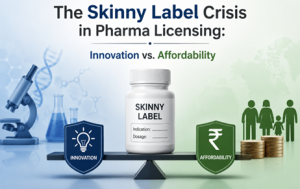
The Skinny Label Crisis in Pharma Licensing: Innovation vs. Affordability
The Skinny Label Crisis in Pharma Licensing: Innovation vs. Affordability
The “skinny label” strategy has emerged as a contentious battleground in pharmaceutical patent law, allowing generic manufacturers to launch products early by carving out patented uses from their FDA-approved labels under Section VIII of the Hatch-Waxman Act. This regulatory carve-out enables market entry for unpatented indications while allegedly sidestepping infringement liability, but courts increasingly view accompanying marketing as “induced infringement.” The 2026 Supreme Court review of Hikma Pharmaceuticals USA v. Amarin Pharma over Vascepa exemplifies this crisis, pitting healthcare affordability against R&D incentives.
Origins of the Skinny Label Mechanism
Enacted in 1984, the Hatch-Waxman Act balanced brand exclusivity with generic competition. Section VIII permits Paragraph IV filers to amend Abbreviated New Drug Applications (ANDAs) with “skinny labels” excluding method-of-use patents still active, bypassing 30-month litigation stays. FDA approval follows if the carve-out label remains safe/effective for remaining indications.
The mechanism addressed “evergreening,” secondary patents extending monopolies beyond compound protection. For multi-indication drugs like Eliquis (blood thinner with atrial fibrillation and DVT patents), generics launch for one use while litigation continues on others. From 2015-2025, skinny labels facilitated 25% of early generic entries, saving $100 billion in consumer costs per HHS estimates.
The Induced Infringement Conflict
Patent holders argue skinny labels induce off-label prescribing. Section 271(b) prohibits active steps encouraging direct infringement. Labels alone rarely suffice, FDA requires safety data referencing patented studies, but marketing materials, press releases, and physician detailing plausibly encourage patented uses, per Global Drones v. IAI North America (Fed. Cir. 2023).
 GSK’s Coreg victory against Teva (Fed. Cir. 2020, en banc 2023) crystallized the risk. Teva’s skinny label omitted heart failure indication, but GSK proved inducement through: (1) public statements touting bioequivalence, (2) medical journal submissions citing efficacy data, and (3) 80% off-label sales. Jury awarded $235 million; Federal Circuit affirmed, rejecting “label immunity.”
Amarin v. Hikma (Vascepa) escalates this. FDA approved Vascepa for severe hypertriglyceridemia (SH, unpatented post-2020) while cardiovascular risk reduction (CV, patented) litigation continued. Hikma’s 2020 skinny label covered SH only, but District of Delaware (2024) found inducement from Hikma’s website (“treat high triglycerides”), slide decks, and sales force scripts implying CV benefits. Federal Circuit affirmed (June 2025), reversing summary judgment; SCOTUS granted certiorari January 2026.
Key Case: Hikma v. Amarin Supreme Court Review
Vascepa generated $2.5 billion peak sales, 90% from CV indication. Hikma launched at 90% discount, capturing 80% market share within months. Amarin alleged Hikma’s communications, press releases (“generic Vascepa now available”), website blurbs, and physician targeting, induced 85% off-label CV prescriptions.
Lower courts split: Delaware found plausible inducement beyond label; Federal Circuit held FDA carve-outs insufficient safe harbor, remanding for trial. SCOTUS consolidated with amici from DOJ (defending skinny labels), PhRMA (innovation harm), and AARP (affordability imperative). Oral arguments probe: Does skinny label compliance negate inducement? How weigh FDA safety data referencing patented uses?
Impact on Innovation Incentives
Brand companies warn skinny labels erode R&D returns. CV indication represented 95% Vascepa revenue; early generic entry slashed Amarin’s market cap 70%. PhRMA cites 20% drop in method-of-use filings post-GSK, chilling $150 billion annual US R&D. Secondary patents fund Phase III trials costing $300 million, without exclusivity, investment dries.
Generics counter: Skinny labels avert evergreening monopolies. Pre-Hatch-Waxman, 40% drugs lacked generics after 20 years; today, 90% within 12 months. $400 billion annual savings fund unbranded access.
Healthcare Affordability Stakes
Patients benefit immensely. Skinny label Eliquis (apixaban) saved $10 billion in 2023 alone; generic statins post-carve-out dropped 85% price. AARP brief notes 25 million Medicare beneficiaries avoid premiums hikes. Hospitals shift budgets from drugs to staff.
Critics highlight induced infringement chilling: Post-GSK, 15% skinny label ANDAs withdrawn, delaying competition 18 months.
Judicial Shift Toward Induced Infringement
Federal Circuit’s trilogy, Teva (2020), Amarin (2025), and Indivior v. Dr. Reddy’s (2024), signals skepticism. Courts scrutinize “totality”: labels, marketing, sales data, expert testimony on physician behavior. Post-approval label amendments (adding indications) trigger re-listing under 21 CFR 314.94.
DOJ amicus warns Federal Circuit overreach undermines congressional intent: Section VIII explicitly authorizes carve-outs without infringement immunity presumption. Patent exhaustion doctrine (Impression Products v. Lexmark, 2017) arguably shields approved uses.
Global Parallels
EU’s Supplementary Protection Certificates permit similar carve-outs under Article 3(b) SPC Regulation, but induced infringement rarer absent direct marketing prohibitions. India’s Section 3(d) Patents Act curtails evergreening; generics dominate 85% market via compulsory licensing.
Japan’s PMDA skinny label equivalents face administrative challenges; Australia’s PBS excludes patented uses from reimbursement.
Strategic Implications for Pharma
Brands: Fortify method patents with robust labeling claims; pursue induced infringement aggressively via 505(b)(2) hybrids. Monitor generic communications pre-launch.
Generics: Bulletproof skinny labels with disclaimers (“not for [patented use]”); limit marketing to carved indications. Paragraph III certifications defer to patent expiry.
Policymakers: FDA guidance on “safe” communications pending; Congress considers Section VIII safe harbors.
SCOTUS resolution could reshape $500 billion US generics market. Narrow inducement (label-alone insufficient) preserves affordability; broad standard (marketing evidence) bolsters innovation. Vascepa’s fate hinges on balancing $2 trillion healthcare spend with $100 billion R&D ecosystem.
Author: Amrita Pradhan, in case of any queries please contact/write back to us via email to [email protected] or at IIPRD.
References
- Amarin Pharma, Inc. v. Hikma Pharmaceuticals USA Inc., No. 24-889 (U.S. Supreme Court, cert. granted 2026).
- GlaxoSmithKline LLC v. Teva Pharmaceuticals USA, Inc., 29 F.4th 1368 (Fed. Cir. 2023).
- 21 U.S.C. § 355(j)(2)(A)(viii) (Hatch-Waxman Act, Section VIII), https://uscode.house.gov/view.xhtml?req=granuleid:USC-prelim-title21-section355.
- Global-Tech Appliances, Inc. v. SEB S.A., 563 U.S. 754 (2011).
- Pharmaceutical Research and Manufacturers of America, Industry Profile and Policy Positions on Patent Protection, https://phrma.org.
- S. Department of Health and Human Services, Office of the Assistant Secretary for Planning and Evaluation, Savings from Generic Drugs in the United States (2023), https://aspe.hhs.gov.
- S. Department of Justice, Amicus Brief in Amarin Pharma v. Hikma Pharmaceuticals (Dec. 2025), https://www.justice.gov.
- AARP, Prescription Drug Cost and Savings Reports, https://www.aarp.org.
- National Center for Biotechnology Information, Generic Drugs and Skinny Labeling in Pharmaceutical Regulation (2024), https://www.ncbi.nlm.nih.gov/pmc.