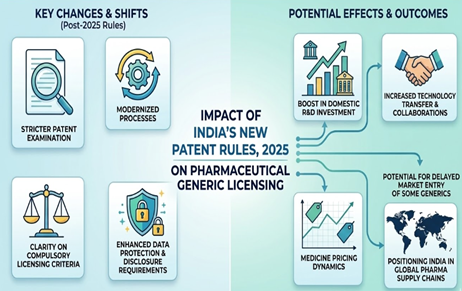
Introduction India plays an important role in the global pharmaceutical industry as a major drug…
IP Licensing as a Strategic Tool in the AI and Digital Content Era
Introduction
In India’s contemporary digital economy, intellectual property licensing has assumed a position of strategic centrality in the commercial exploitation of intangible assets. Across technology, media, and data-driven sectors, licensing has increasingly displaced outright assignment as the preferred mode of IP monetisation, enabling right holders to retain ownership while permitting controlled and differentiated uses. This shift reflects a broader movement from permanent alienation of rights towards purpose-bound and conditional access, driven by commercial flexibility and risk management considerations.
The rapid expansion of artificial intelligence and digital content ecosystems has significantly intensified this trend. AI-enabled technologies depend on continuous access to data, software, and copyrighted works, frequently deployed across jurisdictions with minimal friction. Such cross-border and large-scale uses strain traditional assumptions underlying IP exploitation, including territoriality, identifiable users, and linear modes of dissemination. Existing IP statutes, which remain largely technology-neutral and territorially anchored, offer limited guidance for these modes of exploitation. In this environment, licensing has emerged as the principal contractual mechanism through which uncertainty relating to scope, reuse, and downstream liability is managed.
From an Indian perspective, the strategic importance of licensing is further reinforced by the absence of AI-specific rules in IP statutes and the introduction of a consent-centric data protection regime under the Digital Personal Data Protection Act, 2023. Together, these developments place licensing at the intersection of IP law, data governance, and cross-border commerce. This article examines the evolution of IP licensing in India as a strategic legal and business tool in response to these pressures, focusing strictly on licensing structures, consent models, and risk allocation rather than the technical operation of AI systems.
Legal Architecture of IP Licensing in India
The centrality of licensing in India’s IP ecosystem is grounded in a legal architecture that clearly distinguishes ownership of intellectual property from authorisation of its use. Indian IP statutes consistently recognise licensing as a limited grant of rights, distinct from assignment, thereby enabling right holders to commercialise IP without divesting proprietary interests.
Licensing under Indian copyright law is principally governed by Chapter VI of the Copyright Act, 1957 (Sections 30–32B), which provides a structured framework for voluntary, compulsory, and statutory licences. Similarly, the Patents Act, 1970 recognises voluntary licensing under Section 70 and regulates compulsory licensing under Chapter XVI, reinforcing the principle that patent rights may be exploited through controlled permissions rather than outright transfer. These statutes deliberately refrain from prescribing exhaustive licensing formats, leaving substantial scope for contractual design.
This statutory flexibility is reinforced by the Indian Contract Act, 1872, which accords primacy to party autonomy under Section 10, subject to legality and public policy constraints under Section 23. Consequently, Indian licensing practice is shaped primarily by negotiated commercial objectives rather than predefined legislative templates.
At the international level, this approach aligns with India’s obligations under the Agreement on Trade-Related Aspects of Intellectual Property Rights (TRIPS). While TRIPS mandates minimum standards of IP protection, it does not impose prescriptive licensing models. Articles 28 recognises the right of IP holders to authorise use subject to conditions and exceptions under Article 30 and compulsory licensing under Article 31, while preserving member-state autonomy to regulate licences, particularly in matters of competition and public interest. This treaty framework enables domestic licensing practices to evolve through contract-driven solutions, an aspect of particular significance in technology-intensive and cross-border transactions.
Licensing of Copyrighted Works and Data
In India’s digital economy, the licensing of copyrighted works and data has become the primary mechanism for managing scale, reuse, and legal uncertainty. Contemporary uses frequently involve automated processing, continuous modification, and redistribution across platforms and jurisdictions, uses not expressly contemplated by existing copyright regimes. Licensing therefore operates not merely as permission, but as a strategic structuring tool.
Indian licensing practice increasingly relies on scope-specific and purpose-based grants, wherein permitted uses are contractually tied to defined commercial objectives. This approach allows licensors to retain control over downstream exploitation while enabling licensees to deploy content or datasets efficiently. Duration-based limitations further ensure adaptability in rapidly evolving technological environments.
Territorial controls remain significant despite the borderless nature of digital exploitation. Indian licensors, operating within a territorially bounded IP regime, frequently structure licences with express territorial limitations or conditional sublicensing provisions as a matter of risk management. Such structuring allows licensors to confine authorisation to specified jurisdictions and to allocate regulatory compliance obligations contractually, particularly where licensed material is embedded within AI-enabled systems that may be deployed or accessed across multiple jurisdictions.
Royalty models have also evolved. Fixed-fee structures are increasingly supplemented by usage-linked, output-based, or revenue-sharing mechanisms, reflecting the difficulty of predicting value ex-ante in digital contexts. These models align economic returns with actual commercial performance while preserving flexibility.
Statutorily, Indian copyright law offers limited guidance for such uses. The fair dealing exceptions under Section 52 of the Copyright Act, 1957 remain context-specific and largely untested in relation to large-scale automated reuse. In the absence of legislative clarity, contractual allocation of risk through licensing via representations, warranties, indemnities, and audit rights has become the dominant governance mechanism. To provide accountability and allow creators to confirm unauthorized use, AI developers should verify datasets used for training the public. Even in cases where AI does the final execution, intellectual property rules can be changed to provide credit to human creators for their creative direction and aesthetic input. For training data, fair-use-based licensing programs should be implemented to guarantee that authors get paid when their creations are utilized.
The importance of express licensing in digital environments has been reinforced by the Delhi High Court in MySpace Inc. v. Super Cassettes Industries Ltd., where the Court rejected the notion that large-scale online dissemination or user uploads could give rise to implied licences in favour of digital platforms. The Court held that copyright owners retain exclusive control over commercial exploitation of their works online, and that lawful platform-level use requires authorisation through licensing arrangements, notwithstanding the availability of statutory safe-harbour protections. This decision underscores licensing as the legally sustainable mechanism for authorising use in automated and large-scale digital content ecosystems.
Licensing as a Mechanism of Consent and Control
The evolution of IP licensing in India’s digital economy is closely linked to the increasing centrality of consent as a governing principle. As AI-enabled systems rely on large-scale processing of data, creative works, and identity-linked attributes, licensing has emerged as the principal private-law framework for structuring and allocating responsibility around authorised use, particularly where statutory guidance is limited.
This development is reinforced by the Digital Personal Data Protection Act, 2023 (DPDP Act), which establishes a consent-centric regime for personal data processing. Section 4 permits processing of personal data for a lawful purpose, while Section 6 mandates that consent be free, specific, informed, unconditional, and unambiguous, obtained through affirmative action. This framework clearly favours an opt-in model of authorisation, rendering implied or passive consent structures unsuitable for commercial data exploitation. Although the DPDP Act does not regulate IP licensing or treat consent as a proprietary licence, its requirements significantly influence how datasets containing personal data are commercially deployed.
In practice, licensing agreements function as the contractual vehicle through which DPDP-compliant consent is reflected and implemented, rather than as sources of consent themselves. Data licences increasingly incorporate representations regarding the existence of valid consent, purpose-limitation clauses aligned with consent notices, and warranties allocating responsibility for downstream processing. The obligations imposed on data fiduciaries under Section 8 of the Act further discourage broad, unrestricted data use, thereby favouring narrowly scoped and purpose-bound licences.
This consent-centric licensing logic extends to digital content and personality interests. Indian courts have recognised personality rights through judicial interpretation, grounding protection in the right to privacy and dignity under Article 21 of the Constitution. In cases like Amitabh Bachchan v. Rajat Nagi and Anil Kapoor v. Simply Life India, the Delhi High Court restrained unauthorised commercial exploitation of a person’s name, voice, likeness, and persona. While personality rights are not statutorily codified, these decisions underscore that lawful use of identity-linked attributes hinges on express consent, most effectively structured through licensing arrangements.
Accordingly, while intellectual property law, data protection law, and personality rights remain doctrinally distinct, licensing has increasingly functioned as a common contractual framework for consent, control, and accountability across these domains, particularly in digital and AI-mediated environments where statutory guidance remains fragmented.
Technology and Software Licensing in India
Technology and software licensing functions as an operational design within India’s digital ecosystem, regulating access, functionality, and permissible use. Unlike licences for static works, technology licences govern dynamic systems characterised by updates, interoperability, and continuous deployment. Licensing therefore operates as an ongoing governance mechanism rather than a one-time transactional instrument.
Indian software licensing practices developed through the IT and outsourcing sectors and have since been extended to cloud services, AI tools, and platform-based offerings. Access is typically mediated through licences rather than transfer of source code or ownership, emphasising regulated access over asset transfer.
A critical aspect of technology licensing involves the interaction between open-source and proprietary licensing models. While open-source software remains foundational, its integration into commercial products requires careful compliance with licence terms. Proprietary licensing enables tighter control over use and redistribution, and hybrid licensing structures combining both models are increasingly common.
API-based and platform-based licences exemplify contemporary licensing practice, particularly in cross-border contexts. Field-of-use and sectoral restrictions are frequently employed to manage regulatory exposure. In the absence of AI or software-specific statutory rules, contractual precision determines the effectiveness of these licences.
IP Licensing as a Strategic Business Tool in India
From a commercial perspective, IP licensing has evolved into a strategic business instrument. Licensing enables monetisation without divestment, facilitates cross-border collaboration, and supports market entry while preserving control over intellectual assets.
- For Indian startups, licensing enables scalability and global engagement.
- For media platforms, territorial and duration-based licences support differentiated exploitation.
- For research institutions, licensing governs industry collaboration without compromising ownership.
Crucially, licensing serves as a mechanism for risk allocation and regulatory compliance, particularly where statutory guidance is limited. Governing law clauses, dispute-resolution mechanisms, and compliance warranties allow Indian entities to navigate cross-border complexity. In this sense, licensing functions as infrastructure for digital trade.
Practical Challenges in Indian Licensing Practice
Despite its strategic importance, licensing practice in India faces persistent challenges.
- Enforcement of licence terms across jurisdictions remains complex, particularly where digital dissemination and platform-based deployment blur territorial boundaries of IPRs.
- Licensing arrangements imposed through Standard-form contracts drafted by dominant platforms raise concerns of bargaining imbalance and limited negotiating autonomy for licensees.
- The borderless nature of digital and AI-enabled exploitation complicates the application of territorially grounded IP regimes, increasing reliance on contractual mechanisms for control and compliance.
- Scrutiny under the Competition Commission of India may constrain the enforceability of certain restrictive licensing practices, particularly those affecting market access or competition.
- Enforcement of cross-border licensing which involves overlapping legal regimes, further create uncertainties and raise questions as to governing law, jurisdiction, and dispute resolution mechanisms.
- Licensing transactions involving data, digital content, and technology may simultaneously engage IP law, competition law, and data protection rules, which would require careful contractual structuring to manage regulatory exposure.
Conclusion
In the AI and digital content era, IP licensing in India has evolved from a supplementary commercial arrangement into core legal infrastructure for the organisations who pursue lawful and scalable exploitation of IP assets. As statutory frameworks remain territorially grounded and struggle to keep pace with technological change, licensing has emerged as the principal contractual mechanism through which domestic IP law, data protection obligations, and global digital exploitation are reconciled in practice. Precision in drafting, consent-driven structuring, and adaptability in licensing will therefore play a significant role in determining how effectively India leverages its intellectual capital in an increasingly interconnected economy.
Author: Aditi Yadav, in case of any queries please contact/write back to us via email to [email protected] or at IIPRD.
References
- Copyright Act, 1957, No. 14 of 1957, Government of India (1957).
- Patent Act, 1970, No. 39 of 1970, Government of India (1970).
- Indian Contract Act, 1872, No. 9 of 1872, Government of India (1872).
- Digital Personal Data Protection Act, 2023, No. 22 of 2023, Government of India (2023).
- Competition Act, 2002, No. 12 of 2003, Government of India (2003).
- Agreement on Trade-Related Aspects of Intellectual Property Rights, Apr. 15, 1994, Marrakesh Agreement Establishing the World Trade Organization, Annex 1C, 1869 U.N.T.S. 299 (entered into force Jan. 1, 1995).
- Super Cassettes Industries Ltd. v. MySpace Inc., 2016 SCC OnLine Del 6382 (India).
- Amitabh Bachchan v. Rajat Nagi & Ors., 2022 SCC OnLine Del 4108 (India).
- Anil Kapoor v. Simply Life India & Ors., 2023 SCC OnLine Del 2701 (India).
- Bagath Manish, Indian Perspective of Intellectual Property for AI-Created Works, 3 Trends in Intellectual Property Research 44 (2025).
Related Posts